I apologize for not making a post before now. If you follow Eclectic Otter on Facebook you will have seen a little bit about the issues I've had this past month but here is a longer explanation. Our old camera had died and we were getting ready for vacation so we purchased a new one. I took some pictures for my post at the beginning of the month but had problems getting them to download. In fact, neither my husband nor I have been able to download pictures directly to the laptop still. I was able to get them on to our desktop in the other room because it has a direct SD card slot. After wasting several days trying to figure out that out and the post already being late, I gave up for the moment because we left for vacation that Saturday and I had other issues to worry about. For instance, we ended up taking loaner car on vacation because my husband's cruise control was broken and they were waiting on the part when we left.
I had also intended to have book reviews typed and ready to go before we left so that I could schedule it to post while we were gone but that didn't work out. I thought about doing a quick post after we got home but we got in on Saturday afternoon and that evening had a storm that knocked out our power. We didn't get power back until about 3 pm on Tuesday. Then Wednesday night another storm hit that caused flash flooding and we had to dry out all our carpet.
Things should (fingers crossed) be getting back to normal now and I can get back on track. I have lots of photos to share from my all Wonder Woman vacation wardrobe, to photos from the trip, and even pictures of the kitten we adopted when we got back because.... Oh yeah, we ended up adopting a kitten while our power was out just in case things were getting too quiet. So stay tuned and I'll try to catch up.

Books, Craft, and Geekery
Monday, July 31, 2017

Monday, June 26, 2017
Librocubicularist- June 2017
I really do apologize for being so late posting this. The last few weeks have been really busy. In addition to the never ending battle to keep our yard looking well groomed, my husband and I decided that it was time for us both to get checkups. So we scheduled doctors appointments for both of us, which of course lead to more doctors appointments. I also had some extra crafting for a gift exchange that I participated in that took up a bit of my spare time as well. But you know, there's always time to read, so here are a few things that I squeezed in this month.
 Literary Yarns: Crochet Projects Inspired by Classic Books by Cindy Wang
My rating: 5 of 5 stars
This book is super adorable! It has instructions to make your very own amigurumi style stuffies based on famous literary characters. There are enough details in the direction and variations for hair styles that it seems like it would be easy to create designs for your own characters based on these instructions. There are so many great things here it's hard to choose a favorite, although I think I'm going to go with Anne of Green Gables. There are several with great accessories that make me laugh, such as Captain Ahab with a toothpick peg leg and Julius Ceasar skewered with cocktail swords. There's even a Dr. Jekyl and Mr. Hyde that uses a doll joint so you can turn his head from one face to the other.
 Urban Watercolor Sketching: A Guide to Drawing, Painting, and Storytelling in Color by Felix Scheinberger
My rating: 4 of 5 stars
This book has a lot of basic information about watercolor paint works, how its made, and how it can be used. I also felt like it had good advice about composition and finding your own style.
 Star Wars: Dawn of the Jedi, Volume 1: Force Storm by John Ostrander
My rating: 3 of 5 stars
 This comic series is.... odd. I should say upfront that I've only read the first two so far. I have the third but haven't finished it. The blurb on the back of the book makes it sound like these are about the foundation of the Jedi. It was a little confusing to read at first because there was only a minimum of setup then launched into a story about a whole planet of people who are in balance with the force. There's a race of dark side wielding creatures preparing to attack. As you get further into the story it does begin to explain some things but I still feel confused. I think that a little more explanation up front would have made this series much more enjoyable.
 DIY Temporary Tattoos: Draw It, Print It, Ink It by Pepper Baldwin
My rating: 4 of 5 stars
I have never wanted to get a real tattoo, in part because I've never felt like I had an idea that I wanted to live with permanently. I really still don't but if I did this book would be a big help in working out exactly what I wanted to do. It covers a variety of topics related to tattoo design including subject matter, style, and location. While some of this information is specific to temporary tattoos (like which placements will crack or stretch) I feel like most of it would be relevant to creating actual tattoos. It would be a good way to test out a design before going permanent or just try a variety of things for temporary fun.
Literary Yarns: Crochet Projects Inspired by Classic Books by Cindy WangMy rating: 5 of 5 stars
This book is super adorable! It has instructions to make your very own amigurumi style stuffies based on famous literary characters. There are enough details in the direction and variations for hair styles that it seems like it would be easy to create designs for your own characters based on these instructions. There are so many great things here it's hard to choose a favorite, although I think I'm going to go with Anne of Green Gables. There are several with great accessories that make me laugh, such as Captain Ahab with a toothpick peg leg and Julius Ceasar skewered with cocktail swords. There's even a Dr. Jekyl and Mr. Hyde that uses a doll joint so you can turn his head from one face to the other.
Urban Watercolor Sketching: A Guide to Drawing, Painting, and Storytelling in Color by Felix ScheinbergerMy rating: 4 of 5 stars
This book has a lot of basic information about watercolor paint works, how its made, and how it can be used. I also felt like it had good advice about composition and finding your own style.
Star Wars: Dawn of the Jedi, Volume 1: Force Storm by John OstranderMy rating: 3 of 5 stars
 This comic series is.... odd. I should say upfront that I've only read the first two so far. I have the third but haven't finished it. The blurb on the back of the book makes it sound like these are about the foundation of the Jedi. It was a little confusing to read at first because there was only a minimum of setup then launched into a story about a whole planet of people who are in balance with the force. There's a race of dark side wielding creatures preparing to attack. As you get further into the story it does begin to explain some things but I still feel confused. I think that a little more explanation up front would have made this series much more enjoyable.DIY Temporary Tattoos: Draw It, Print It, Ink It by Pepper Baldwin
My rating: 4 of 5 stars
I have never wanted to get a real tattoo, in part because I've never felt like I had an idea that I wanted to live with permanently. I really still don't but if I did this book would be a big help in working out exactly what I wanted to do. It covers a variety of topics related to tattoo design including subject matter, style, and location. While some of this information is specific to temporary tattoos (like which placements will crack or stretch) I feel like most of it would be relevant to creating actual tattoos. It would be a good way to test out a design before going permanent or just try a variety of things for temporary fun.
Monday, June 12, 2017
Dining Room Curtains- Finally
After having the fabric in our house for over five years, I have finally finished making curtain panels for our dining room.
There have been many missteps that delayed this particular project. Way back when I first started the project they were intended to be made with only two fabrics, the green print for the main portion and a white bit on the top with tabs. However, I miscalculated and didn't buy enough fabric so I needed to add on to the sides. I eventually went with the pale blue because it was inexpensive and matched our wall color.


There have been many missteps that delayed this particular project. Way back when I first started the project they were intended to be made with only two fabrics, the green print for the main portion and a white bit on the top with tabs. However, I miscalculated and didn't buy enough fabric so I needed to add on to the sides. I eventually went with the pale blue because it was inexpensive and matched our wall color.

Materials:
Main Fabric (green and white) 3 yds
Top Fabric (white) 1.5 yds
Side Fabric (blue) 3 yds
Curtain Clips and rod
Step One: Cut Fabrics to Size ( I used a rotary cutter and mat.)
The green bird fabric is the easiest to cut, it just needed to be cut in half to make two 54x54 pieces.
Cut the blue in half long ways to make two long strips, 54x22.
Cut the white into 3 equal pieces about 15x 54.
Step Two: Make Header
Sew the white pieces together to create on long strip 15 inches tall by 162 inches long.
There should be enough leftover to make tabs for the top but after seeing how much easier our living curtains are to open with the rings I decided to use them in the dining room as well.

Step Three: Sew on Side Panels
Sew one blue panel to the right side of a green panel. Sew the remaining blue panel on the left side of the other green panel.

Step Four: Sew Header
Sew the white header strip across the top of one curtain panel. Cut off the remaining portion and use it for the other panel.
 |
| You should have two panels with the blue edges creating an outside border. |
Step Five: Hem all Sides
I used a small hem, maybe 1/2 inch, on the sides and bottom of the panels. I wanted the top to be a bit thicker since it was going in the clips so I made a wider hem, about 1 inch, double folded.
I decided to leave this set of curtains unlined because we don't usually have a problem with the extra light, we just needed something to give us a bit of privacy. Prior to this we just had the mini-blinds that were there when we moved in. We've recently moved a small cat tower near this window and wanted to get rid of the blinds to eliminate chances for them to be tangled in the blind cords.
Now you're ready to hang your curtains! I wanted to use a branch to tie in with the bird on a branch fabric so we save one that seemed about the right size. The plan was to spray paint it either white or silver and use it in place of a curtain rod. Here's a picture of the curtains with the branch before it got painted.


For the most part, it works but there are a few problems. First of all, it has a bit too much of a curve to it because it is hard to get the ends in the brackets without the middle being pressed to close to the wall. It is also a bit too big around at a few points making it impossible for the rings to slide the whole length. So now I'm trying to decide what I want to do with it.
I have several options:
1. Just give up and buy a curtain rod.
2. Find an entirely new stick that is thinner and straighter.
3. Cut and or sand this stick down in the necessary places until it works.
I lean towards and kind of 1, 3 combo. Buying a super cheap temporary rod to use while I modify our stick.
Gil hung out with me while I was sewing using the table and fabric draped over it as a doggy fort.

Monday, May 22, 2017
Librocubicularist- May 2017
During this past month, we have still been working on getting our yard back in shape. It's still been rainy off and on so we keep getting interrupted, but it's finally starting to look okay. We still have lots to do including digging up a bunch of stumps from the brush we cut down.
I am working on sewing curtains for our dining room. Finally. The fabric for them has been in the closet for years and I even tried to start them last April when I posted about making curtains for our bedroom and office. I am hoping to be able to share them with you in my next post. However, I did take a short break to make a quick skirt using this awesome Legend of Zelda fabric that I bought.


 No Excuses Watercolor: Painting Techniques for Sketching and Journaling by Gina Rossi Armfield
My rating: 5 of 5 stars
The main section of this book is a discussion about the paints themselves and other supplies you may need. Then it goes over some basic techniques. While it does mention that drawing well is important to be able to watercolor well they do offer suggestions to be able to practice without drawing. Mainly that means tracing a design and there are several simple outlines provided in the book that you can use. The same section provides additional ideas for subjects, associated color palettes, and related quotes you could add to your design. I get the feeling that this book oversimplifies things immensely, but it does make me feel like I could possibly paint something at least passable so I think that might be okay. I think I might try to do a watercolor portrait of our dog and depending on how that goes try other things.
 Fat Quarters: Small Fabrics, More Than 50 Big Ideas by Amanda Carestio
My rating: 3 of 5 stars
There is a LOT you can make with just a little bit of fabric and this book shows you how to do it. The projects range over several categories including baby clothes, home decor items, and bags. There are even some projects for quilts though they obviously require multiple fat quarters. My favorite project is the bookshelf tote. I've seen pictures of several quilts with this type of pattern but this is the first time I've seen instructions for it. It seems much easier than I expected and I can't wait to try it out. Other favs are the small first aid kit, stuffed birds, and the fruit pop tea towels.
 Tidy Hacks: Handy Hints to Make Life Easier by Dan Marshall
My rating: 3 of 5 stars
I've seen a lot of these at various places over the internet, but there's something to be said for having them gathered together in a single volume for easy reference. There are some attempts at humor that make it a little weird in places, such as the male author joking about how much makeup he owns and needs to organize, but overall I think it had some handy ideas for storage and organization.
I am working on sewing curtains for our dining room. Finally. The fabric for them has been in the closet for years and I even tried to start them last April when I posted about making curtains for our bedroom and office. I am hoping to be able to share them with you in my next post. However, I did take a short break to make a quick skirt using this awesome Legend of Zelda fabric that I bought.

Bonus Pic of Gil being adorable and 'helping' me sew. He's been super photogenic lately.

I have done more reading this month but somehow haven't found time to write up reviews for them. I have a lot going on during the next couple of weeks but if I get a chance I will add them in later.
No Excuses Watercolor: Painting Techniques for Sketching and Journaling by Gina Rossi ArmfieldMy rating: 5 of 5 stars
The main section of this book is a discussion about the paints themselves and other supplies you may need. Then it goes over some basic techniques. While it does mention that drawing well is important to be able to watercolor well they do offer suggestions to be able to practice without drawing. Mainly that means tracing a design and there are several simple outlines provided in the book that you can use. The same section provides additional ideas for subjects, associated color palettes, and related quotes you could add to your design. I get the feeling that this book oversimplifies things immensely, but it does make me feel like I could possibly paint something at least passable so I think that might be okay. I think I might try to do a watercolor portrait of our dog and depending on how that goes try other things.
Fat Quarters: Small Fabrics, More Than 50 Big Ideas by Amanda CarestioMy rating: 3 of 5 stars
There is a LOT you can make with just a little bit of fabric and this book shows you how to do it. The projects range over several categories including baby clothes, home decor items, and bags. There are even some projects for quilts though they obviously require multiple fat quarters. My favorite project is the bookshelf tote. I've seen pictures of several quilts with this type of pattern but this is the first time I've seen instructions for it. It seems much easier than I expected and I can't wait to try it out. Other favs are the small first aid kit, stuffed birds, and the fruit pop tea towels.
Tidy Hacks: Handy Hints to Make Life Easier by Dan MarshallMy rating: 3 of 5 stars
I've seen a lot of these at various places over the internet, but there's something to be said for having them gathered together in a single volume for easy reference. There are some attempts at humor that make it a little weird in places, such as the male author joking about how much makeup he owns and needs to organize, but overall I think it had some handy ideas for storage and organization.
Monday, May 8, 2017
Hula Hoop Wreath
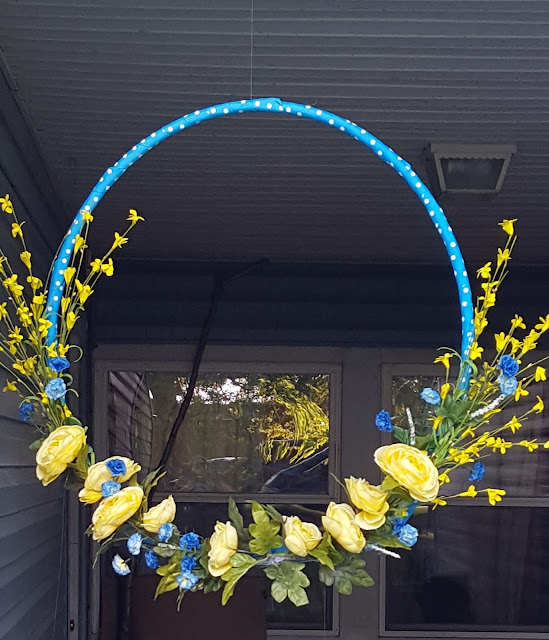
Our house has a covered walkway between the main house and the garage that functions kind of like a porch. I have very mixed emotions about it. On the one hand, it's great, no matter how hard it's raining or how windy it may be you have shelter while you try to unlock the door. On the other hand, it keeps light from reaching our front windows so the living room is dark and there's no way to see the door from the street so any decorations, like a wreath, are lost.
So when I started seeing wreaths made using hula hoops I thought, 'Hey, that might be big enough to hang out front and not disappear'.
Supplies:
Hula Hoop
Selection of fake flowers
Wire Cutter
Glue Gun
Ribbon (optional)


So when I started seeing wreaths made using hula hoops I thought, 'Hey, that might be big enough to hang out front and not disappear'.
Supplies:
Hula Hoop
Selection of fake flowers
Wire Cutter
Glue Gun
Ribbon (optional)

The first step is to separate the clusters of flowers using wire cutters to snip the individual stems.

Then lay them out around the hoop until you get a good idea of what you want the finished product to look like. I decided on a somewhat asymmetrical design with just accents of blue flowers.

Once you decide on the design, glue the flowers in place. I started on the outsides and worked towards the middle.


As you work, you will probably end up with bits that stick out, like in the photo below. You can trim these with the wire cutters.

When you get to the center, pay close attention to how the flowers overlap and try to hide the stems and wires under leaves or blossoms.

At this point, if you can wrap the exposed parts of the hoop with a coordinating ribbon. Glue the end and add a bit of glue every few loops until you reach the other end. Or if you like the color of the hoop you used, you can leave it plain. Here are pictures of mine both before and after the ribbon. I'm still not sure which way I prefer.


To hang the wreath....
Supplies:
Sticky Hook
Fishing Line
Stakes for landscaping fabric

I attached the sticky hook to the ceiling of our walkway. In order to protect the flowers, at least somewhat, from wind and rain, I put it about a foot back from the outside edge. Make a loop with the fishing line and attach it to the hook.

Loop the other end through the hoop and decide how high you want it to hang. Tie the end to the hoop. Use two other pieces of fishing line to keep the wreath from spinning. Tie one end of each to the hoop, near the bottom (one on each side) and secure the other end to the landscaping hooks. Push the hooks into the ground under the wreath so it stays facing forward.


Monday, April 24, 2017
Librocubicularist April 2017
This has not been a great month for reading.
Mondays are my regular day off and usually when I make my weekly run to the library. On the 10th I wasn't able to go because I had jury duty. Then last week, the 17th I spent all day doing yard work and was only able to return what I had due, not much time for browsing. In fact, the entire past two weeks have been filled with yard work. We've been working to get the weeds and brush along all of our fence cleared out and it has not gone smoothly. First, my husband got sick and spent much of the first week unable to help. With my allergies and asthma problems, I can only work a little bit at a time before I have to rest and breathe. Plus, it has rained quite a bit over the past weeks as well which made things more difficult. We got a lot done but it still needs some work and after two weeks cutting and trimming my allergies have caught up to me and I'm sick with a sore throat and coughing.

 Geeky Lego Crafts: 21 Fun and Quirky Projects by David Scarfe
My rating: 3 of 5 stars
While I agree with the fun and quirky tagline, I don't necessarily think everything qualifies as geeky. Sure, there are space invaders, and retro controller but what exactly makes a rubber duck geeky? I'm not sure. However, that being said the instructions seem well done and easy to follow. They are in typical Lego fashion with pictures only and no words. I feel like my husband needs a cassette tape mail sorter and retro game controller phone charging station for his desk at work. The only thing I would change would be to include part numbers for the Legos. If you already have a pile it's easy enough to find a 2x3 brick but when you need to order extras, that's not always how they are identified online.
 Brief Histories of Everyday Objects by Andy Warner
My rating: 4 of 5 stars
Did you ever wonder where toothbrushes came from or who invented the paperclip? Then this is a great book for you. It contains comics that present short, humorous histories of things we use every day. There are some inspirational stories of people using their ideas to get ahead as well as multiple stories where the inventors never patented their products. The story about cinnamon and giant birds, in particular, made me laugh.
It's sad but I only have about six books finished this month, most of them very visual. Hopefully, I'll be back to my normal, non-allergy hazed self soon and get more done.
Mondays are my regular day off and usually when I make my weekly run to the library. On the 10th I wasn't able to go because I had jury duty. Then last week, the 17th I spent all day doing yard work and was only able to return what I had due, not much time for browsing. In fact, the entire past two weeks have been filled with yard work. We've been working to get the weeds and brush along all of our fence cleared out and it has not gone smoothly. First, my husband got sick and spent much of the first week unable to help. With my allergies and asthma problems, I can only work a little bit at a time before I have to rest and breathe. Plus, it has rained quite a bit over the past weeks as well which made things more difficult. We got a lot done but it still needs some work and after two weeks cutting and trimming my allergies have caught up to me and I'm sick with a sore throat and coughing.
 Geeky Lego Crafts: 21 Fun and Quirky Projects by David Scarfe
My rating: 3 of 5 stars
While I agree with the fun and quirky tagline, I don't necessarily think everything qualifies as geeky. Sure, there are space invaders, and retro controller but what exactly makes a rubber duck geeky? I'm not sure. However, that being said the instructions seem well done and easy to follow. They are in typical Lego fashion with pictures only and no words. I feel like my husband needs a cassette tape mail sorter and retro game controller phone charging station for his desk at work. The only thing I would change would be to include part numbers for the Legos. If you already have a pile it's easy enough to find a 2x3 brick but when you need to order extras, that's not always how they are identified online.
Brief Histories of Everyday Objects by Andy WarnerMy rating: 4 of 5 stars
Did you ever wonder where toothbrushes came from or who invented the paperclip? Then this is a great book for you. It contains comics that present short, humorous histories of things we use every day. There are some inspirational stories of people using their ideas to get ahead as well as multiple stories where the inventors never patented their products. The story about cinnamon and giant birds, in particular, made me laugh.
It's sad but I only have about six books finished this month, most of them very visual. Hopefully, I'll be back to my normal, non-allergy hazed self soon and get more done.
Monday, April 10, 2017
Top 10 Things I Want in a DnD Game
I am a member of a group on facebook where there are frequent discussions about what exactly makes a good roleplaying campaign. The problem with these conversations is that the answer isn't the same for everyone but some people think it should be. There's no way that you can design and Dungeons and Dragons campaign that is going to satisfy all the people all of the time. This is why it's important to talk to your player's and find out exactly what sort of game they're hoping for. Some people love a good dungeon crawl, other people find them boring and tedious but most of the time you can find some type of balance to keep everyone interested.
It's been awhile since I was actually involved in any roleplaying game. Our Monday night group changed things up quite a bit trying new games and occasional just doing board games but that ended almost a year ago now due to increased obligations and scheduling conflicts. We played in a game every Sunday for a long time (It's actually where I met my husband) but with it being the only day Bear and I have off together it got to be too much. They've since switched it a Saturday game so he rejoined and games while I'm at work.
For a while now I've been thinking about doing a post about the sort of game that I'd like to play in if I had the opportunity but been hesitant. I don't really know for sure how many of the people from my previous gaming experiences read this blog but there may be things that make them feel like they've been doing it wrong and that's not what I'm going for. So, obviously, at this point, I've decided to just plunge ahead and do it but with a small disclaimer. If you recognize yourself in any of the stories below or disagree in any manner with what I'm saying here, it doesn't mean I think you're wrong or in any way dislike you as an individual, it just means we probably aren't very compatible gaming buddies.
1. I want to play in a world I know. (Unless there's a reason I don't know things.)
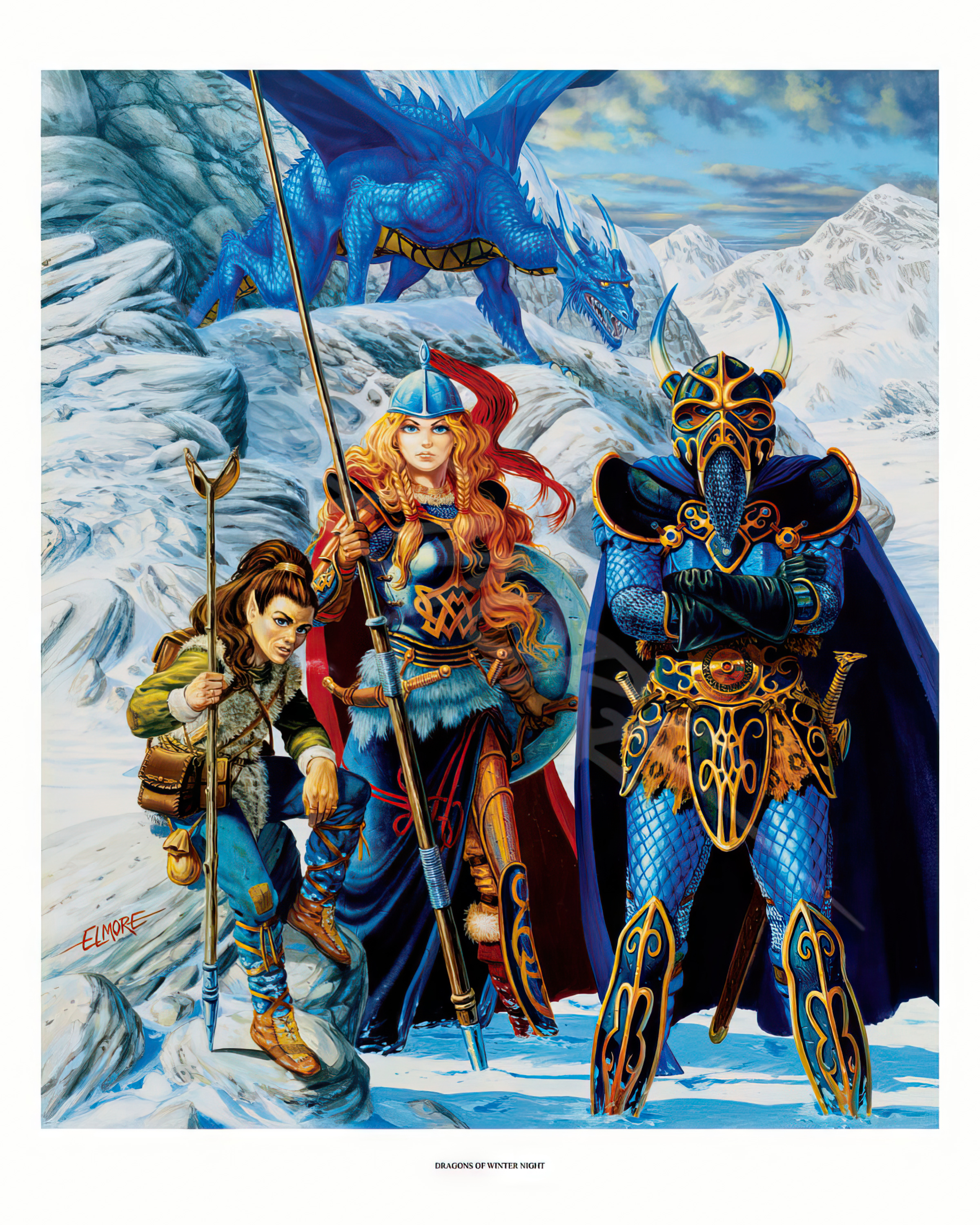
Somehow before I really started gaming much I read a bunch of the Dragonlance novels but when I actual joined a Dungeons and Dragons game everything was set in the Forgotten Realms world. While I don't recall the exact details anymore I clearly remember a session where the party found some kind of emblem or patch on the ground. When it was described everyone else in the game immediately recognized it but I didn't. So I had to ask what was going on which was frustrating. Since then I've read some of the novels from other settings but not many, so I continue to try and convince people they should run a game in Kyrnn.
There are ways to handle this kind of thing that make it better. For instance, if you've watched the Harry Potter movies you'll remember the part where the dark mark first shows up and Harry has no idea what's going on. First of all, there is an explanation built into the story for why Harry doesn't recognize it and second, Ron and Hermione immediately explain things to him.
My husband has been trying to create his own game world so he can include all the miscellaneous elements he enjoys in one place. He ran a campaign in this setting (although it was only partly formed at the time) where the players are all from the same isolated mountain village and don't know much of anything about the outside world. The idea was that they could all explore, discover, and learn about the world as they went. Unfortunately, the party didn't spend a lot of time wandering or asking questions about how things worked, but I like that everyone started with same base knowledge.
2. No one wants to die.
Let's be honest here, I take FOREVER to make a character. I've spent hours just trying to pick the right name, and unlike others, I play with I don't have dozens of character ideas just hanging out ready to go. So I don't want my character to die. I don't want to have to start over and find a reason to get shoehorned into the plot/party. This goes includes my familiar/ animal companion. If you kill them I will be sad. I will find a replacement so that the ability doesn't go to waste but it'll never be the same as the original.
However, I also feel that having zero threat to your character can make things pretty boring. I don't necessarily want to automatically win any challenge I come up against. There's a certain fun in retreating to have a strategy session with the party where you need to find a better approach to the fight or way to avoid that fight altogether. Which, coincidentally, brings us to my third point...
3. Non-combat Challenges
I completely understand that some people play Dungeons and Dragons for the express purpose of killing things. Maybe you had a difficult week and struggled to keep your temper in check and just want to relax by smashing some goblin skulls. I've been there. But I'd still like a chance to have some non-combat encounters. Is there a way to bluff or charm my way in instead of killing the guards? Can I sneak by? Maybe make some kind of knowledge check to find a weakness and trap my enemies with a cave-in?
4. Not (Always) the End of the World
I'm not sure why but it seems like the last several campaigns I was involved with were all super serious if you don't stop this the world is going to end style stories. It's not the end of world scenario itself that bothers me really. It's being a first or second level character who's told that without their intervention the entire universe will be destroyed. I know our characters are supposed to be heroic and stuff but that's a lot of pressure. I think what I would prefer is to start out at low levels with a couple of quests that don't necessarily seem connected. Then as you investigate what's happening you begin to discover how they relate and by the time you put everything together to discover the world ending plot you've come too far with everything to back out. (And happen to have leveled up to a point where taking on that sort of challenge makes sense.)
5. Downtime and Crafting
I would really like to be able to do some item crafting. Part of the issues with this are no longer valid. As I said it's been a while since I played in a game. There was a point where making your own magic items came with an experience point cost, which meant that you ended up being lower level than the rest of the party and that sucked. However, downtime has always been a thing. What does your party do when you aren't out adventuring? Do you all have a place together or separate apartments? Do you have day jobs?
Some people may feel that this is a waste of time but I don't. It can help to create connections between party member and offer easy ways to get information into the party. If you are out shopping you might overhear something related to the plot without actually having set out to gather info. I mean, I'm not saying there might not need to be some kind of listen check or something but it offers a means to have the party stumble across things sometimes. I also think that taking the time to role-play some of the typical downtime activities, like selling loot, offer a chance to use skills more creatively. No one ever takes the appraise skill anymore, at least no one in the groups we play in because it doesn't get used. All the loot just gets kind of automatically traded in for standard value. But that's boring. What if you knew that weapon seller was trying to con you? Offering low prices for a valuable item? Would you still just sell the item or try to find a way to use it? Maybe hold onto it until you find another shop to sell to? What happens then, are you carrying too much stuff, do you start your own shop? I really think that could add another level of interest to the game.
The idea of playing a married couple in a game came up in conversation and I had the idea to take it a step further and have kids as well. Well, obviously kids can't come and be involved in combat so what do you do with them? Enter the Nanny follower. We decided that if one of the parents took the leadership feat and had a follower they could 'hire' a nanny and we started brainstorming what the best class would be for a nanny. The character isn't completely finished but we created a half-orc bard/ nanny. Bards get perform skills, they can have storytelling and music to keep the kids entertained and lull them to sleep. They tend to be high dex high charisma characters so they can use diplomacy to convince the kids to behave, bluff them into believing vegetables have magic powers and use slight of hand to hide the last cookie so no one fights over it. However, it's likely none of those things will ever come up if you aren't actually roleplaying your downtime.
6. Talk to your players about what kind of game you're planning
I have, occasionally, gotten stuck with a character idea that just doesn't fit in a campaign. I appreciate gamemasters who are willing to let me play something a bit odd but be honest about how it is going to fit in. A druid isn't going to the most useful class if all the action takes place in a city. A halfling who rides a dinosaur is awesome until the dino can't fit into half the locations you visit and ends up waiting outside. It's no fun to be stuck with something that isn't working in the context of the adventure so do everyone a favor and be upfront about things that might be a problem.
7. Character Connections and Motivation
It is a cliche that every DnD adventure starts in a tavern, but you know, sometimes they do. If the party meets for the first time at the start of the adventure then sometimes it can be difficult to keep it together. After the initial danger has passed, why do you continue to travel together? Most of the games I've been in this just gets glossed over. You stay together because it's what you need to do to stay in the game, or everyone is motivated to get more loot. While money and treasure are certainly a valid motivation it can get old and sometimes doesn't really work for the characters, for example, monks with the vow of poverty. Having some other kind of motivation to keep the players engaged in the story is important. Maybe your family's honor is at stake or the villains have recruited your brother to be a part of their plot and you need to find a way to not only stop them but do it in a way that saves him from his poor life choices.
This gets easier if you start with a party that already knows each other. Some games like Fate Core have built in connections between players and because of that you get dragged along into things you're character might normally avoid. For instance, I had a character who, as part of the backstory was kidnapped by evil wizards for some kind of weird ritual. Turns out that one of the other players was the son and heir to one of the lead wizards and decided to try and stop the ritual and rescue everyone. Now, my character didn't need a ton of help but once you go through some crazy kidnapping scenario which someone you are more likely to show up when they call later needing backup.
8. Props
Some props are obvious, like having a map to visualize where you are in relation to the enemy during battle. Others can help you feel more immersed by involving your physical senses. Actually holding that ransom note makes it more real. Sometimes puzzles are easier to solve when you can see the components or physically manipulate them like your character would. Picture of a real place that you think help evoke the feel of the place your players are visiting could also add some wider context and maybe save time reading descriptions by just showing the visual.
One of my favorite gaming moments connects back to a prop. We played a game in Ptolus which has a ton of visual aids and such that come with the setting. At the beginning of the adventure the party meet for lunch and we had the actual menu for the place we stopped. Well, it led to an out of character conversation about the type of place it was. We finally decided it maybe kind of like the Cheesecake Factory. Later, when we discovered the restaurant was a front for one of the cities crime families we ended up breaking in to steal some information. As part of the heist we searched for and found the secret cheesecake recipe and it never would have come about without the menu prop.
I like the idea of using more props in games and having the physical connection to things but I admit I don't have good ideas about how to do it. We have some really cool fantasy coins that I'd love to use somehow but so far haven't had any ideas about. Right now we mostly use them as score tokens for board games.

9. Character vs Player Skills
This is a hard one to do well. Part of the appeal of roleplaying games is having a chance to be someone you're not or at least a more heroic version of yourself. Since I am a very quiet introverted person for me that can mean playing a character more outgoing and talkative than myself. This requires a lot of patience on the part of the GM and other players. Just because my character is charismatic and knows what to say and how to it say it diplomatically doesn't mean that I do and it certainly doesn't mean I can do it spur of the moment. I'm going to need a bit of time to think about how I want to say things and may not always have a great way to phrase thing. I may only be able to offer a general idea of what I want to say, not actually lay it all out exactly as I want it said. I understand that that is not great roleplay but I need a group that understands my skills don't always match up with my character's skills and will be willing to work with me to get better and get out of my comfort zone sometimes.
10. Setting and Game Length
Over the years I've played in games of various lengths and results vary as well. If you have a free day it can be tempting to schedule a marathon session but that might not be the best plan. It is hard to keep your focus for long period of time even while doing something you love. You get restless and have to shift around or your mind starts to wander. If you have a session that's long enough to require a break for a meal, that makes it even harder to focus. For a long time, we had a game that included a dinner break but was a fend for yourself kind of situation. So I'd often find my mind wandering during combat to where I could go for dinner that was close and in my budget. Then after waiting for everyone to return it took a while for everyone to settle back down and refocus on the game. On the other end of the scale, we hosted a weeknight game from 6-10pm that started with dinner. It gave everyone a chance to talk and catch up while eating then we were full and ready to focus on the fun game ahead.
The other factor to consider is where you want to play. If you opt for the couch everyone will be comfortable, but it can be hard for everyone to see any maps you might use and it makes dice rolling difficult. Plus, people can be too comfortable and fall asleep, I've seen it happen. If you game at a table everyone can see the map, reach to position their own mini, and has a surface to roll on. Yeah, you might have more comfort issues but as long as you keep sessions to a reasonable length it shouldn't be a big deal.
It's been awhile since I was actually involved in any roleplaying game. Our Monday night group changed things up quite a bit trying new games and occasional just doing board games but that ended almost a year ago now due to increased obligations and scheduling conflicts. We played in a game every Sunday for a long time (It's actually where I met my husband) but with it being the only day Bear and I have off together it got to be too much. They've since switched it a Saturday game so he rejoined and games while I'm at work.
 |
| Blue Dragon |
For a while now I've been thinking about doing a post about the sort of game that I'd like to play in if I had the opportunity but been hesitant. I don't really know for sure how many of the people from my previous gaming experiences read this blog but there may be things that make them feel like they've been doing it wrong and that's not what I'm going for. So, obviously, at this point, I've decided to just plunge ahead and do it but with a small disclaimer. If you recognize yourself in any of the stories below or disagree in any manner with what I'm saying here, it doesn't mean I think you're wrong or in any way dislike you as an individual, it just means we probably aren't very compatible gaming buddies.
1. I want to play in a world I know. (Unless there's a reason I don't know things.)
Somehow before I really started gaming much I read a bunch of the Dragonlance novels but when I actual joined a Dungeons and Dragons game everything was set in the Forgotten Realms world. While I don't recall the exact details anymore I clearly remember a session where the party found some kind of emblem or patch on the ground. When it was described everyone else in the game immediately recognized it but I didn't. So I had to ask what was going on which was frustrating. Since then I've read some of the novels from other settings but not many, so I continue to try and convince people they should run a game in Kyrnn.
There are ways to handle this kind of thing that make it better. For instance, if you've watched the Harry Potter movies you'll remember the part where the dark mark first shows up and Harry has no idea what's going on. First of all, there is an explanation built into the story for why Harry doesn't recognize it and second, Ron and Hermione immediately explain things to him.
My husband has been trying to create his own game world so he can include all the miscellaneous elements he enjoys in one place. He ran a campaign in this setting (although it was only partly formed at the time) where the players are all from the same isolated mountain village and don't know much of anything about the outside world. The idea was that they could all explore, discover, and learn about the world as they went. Unfortunately, the party didn't spend a lot of time wandering or asking questions about how things worked, but I like that everyone started with same base knowledge.
 |
| Dragons of Winter Night |
2. No one wants to die.
Let's be honest here, I take FOREVER to make a character. I've spent hours just trying to pick the right name, and unlike others, I play with I don't have dozens of character ideas just hanging out ready to go. So I don't want my character to die. I don't want to have to start over and find a reason to get shoehorned into the plot/party. This goes includes my familiar/ animal companion. If you kill them I will be sad. I will find a replacement so that the ability doesn't go to waste but it'll never be the same as the original.
However, I also feel that having zero threat to your character can make things pretty boring. I don't necessarily want to automatically win any challenge I come up against. There's a certain fun in retreating to have a strategy session with the party where you need to find a better approach to the fight or way to avoid that fight altogether. Which, coincidentally, brings us to my third point...
3. Non-combat Challenges
I completely understand that some people play Dungeons and Dragons for the express purpose of killing things. Maybe you had a difficult week and struggled to keep your temper in check and just want to relax by smashing some goblin skulls. I've been there. But I'd still like a chance to have some non-combat encounters. Is there a way to bluff or charm my way in instead of killing the guards? Can I sneak by? Maybe make some kind of knowledge check to find a weakness and trap my enemies with a cave-in?
4. Not (Always) the End of the World
I'm not sure why but it seems like the last several campaigns I was involved with were all super serious if you don't stop this the world is going to end style stories. It's not the end of world scenario itself that bothers me really. It's being a first or second level character who's told that without their intervention the entire universe will be destroyed. I know our characters are supposed to be heroic and stuff but that's a lot of pressure. I think what I would prefer is to start out at low levels with a couple of quests that don't necessarily seem connected. Then as you investigate what's happening you begin to discover how they relate and by the time you put everything together to discover the world ending plot you've come too far with everything to back out. (And happen to have leveled up to a point where taking on that sort of challenge makes sense.)
 |
| Dwarf Forge |
5. Downtime and Crafting
I would really like to be able to do some item crafting. Part of the issues with this are no longer valid. As I said it's been a while since I played in a game. There was a point where making your own magic items came with an experience point cost, which meant that you ended up being lower level than the rest of the party and that sucked. However, downtime has always been a thing. What does your party do when you aren't out adventuring? Do you all have a place together or separate apartments? Do you have day jobs?
Some people may feel that this is a waste of time but I don't. It can help to create connections between party member and offer easy ways to get information into the party. If you are out shopping you might overhear something related to the plot without actually having set out to gather info. I mean, I'm not saying there might not need to be some kind of listen check or something but it offers a means to have the party stumble across things sometimes. I also think that taking the time to role-play some of the typical downtime activities, like selling loot, offer a chance to use skills more creatively. No one ever takes the appraise skill anymore, at least no one in the groups we play in because it doesn't get used. All the loot just gets kind of automatically traded in for standard value. But that's boring. What if you knew that weapon seller was trying to con you? Offering low prices for a valuable item? Would you still just sell the item or try to find a way to use it? Maybe hold onto it until you find another shop to sell to? What happens then, are you carrying too much stuff, do you start your own shop? I really think that could add another level of interest to the game.
The idea of playing a married couple in a game came up in conversation and I had the idea to take it a step further and have kids as well. Well, obviously kids can't come and be involved in combat so what do you do with them? Enter the Nanny follower. We decided that if one of the parents took the leadership feat and had a follower they could 'hire' a nanny and we started brainstorming what the best class would be for a nanny. The character isn't completely finished but we created a half-orc bard/ nanny. Bards get perform skills, they can have storytelling and music to keep the kids entertained and lull them to sleep. They tend to be high dex high charisma characters so they can use diplomacy to convince the kids to behave, bluff them into believing vegetables have magic powers and use slight of hand to hide the last cookie so no one fights over it. However, it's likely none of those things will ever come up if you aren't actually roleplaying your downtime.
6. Talk to your players about what kind of game you're planning
I have, occasionally, gotten stuck with a character idea that just doesn't fit in a campaign. I appreciate gamemasters who are willing to let me play something a bit odd but be honest about how it is going to fit in. A druid isn't going to the most useful class if all the action takes place in a city. A halfling who rides a dinosaur is awesome until the dino can't fit into half the locations you visit and ends up waiting outside. It's no fun to be stuck with something that isn't working in the context of the adventure so do everyone a favor and be upfront about things that might be a problem.
 |
7. Character Connections and Motivation
It is a cliche that every DnD adventure starts in a tavern, but you know, sometimes they do. If the party meets for the first time at the start of the adventure then sometimes it can be difficult to keep it together. After the initial danger has passed, why do you continue to travel together? Most of the games I've been in this just gets glossed over. You stay together because it's what you need to do to stay in the game, or everyone is motivated to get more loot. While money and treasure are certainly a valid motivation it can get old and sometimes doesn't really work for the characters, for example, monks with the vow of poverty. Having some other kind of motivation to keep the players engaged in the story is important. Maybe your family's honor is at stake or the villains have recruited your brother to be a part of their plot and you need to find a way to not only stop them but do it in a way that saves him from his poor life choices.
This gets easier if you start with a party that already knows each other. Some games like Fate Core have built in connections between players and because of that you get dragged along into things you're character might normally avoid. For instance, I had a character who, as part of the backstory was kidnapped by evil wizards for some kind of weird ritual. Turns out that one of the other players was the son and heir to one of the lead wizards and decided to try and stop the ritual and rescue everyone. Now, my character didn't need a ton of help but once you go through some crazy kidnapping scenario which someone you are more likely to show up when they call later needing backup.
8. Props
Some props are obvious, like having a map to visualize where you are in relation to the enemy during battle. Others can help you feel more immersed by involving your physical senses. Actually holding that ransom note makes it more real. Sometimes puzzles are easier to solve when you can see the components or physically manipulate them like your character would. Picture of a real place that you think help evoke the feel of the place your players are visiting could also add some wider context and maybe save time reading descriptions by just showing the visual.
One of my favorite gaming moments connects back to a prop. We played a game in Ptolus which has a ton of visual aids and such that come with the setting. At the beginning of the adventure the party meet for lunch and we had the actual menu for the place we stopped. Well, it led to an out of character conversation about the type of place it was. We finally decided it maybe kind of like the Cheesecake Factory. Later, when we discovered the restaurant was a front for one of the cities crime families we ended up breaking in to steal some information. As part of the heist we searched for and found the secret cheesecake recipe and it never would have come about without the menu prop.
I like the idea of using more props in games and having the physical connection to things but I admit I don't have good ideas about how to do it. We have some really cool fantasy coins that I'd love to use somehow but so far haven't had any ideas about. Right now we mostly use them as score tokens for board games.

9. Character vs Player Skills
This is a hard one to do well. Part of the appeal of roleplaying games is having a chance to be someone you're not or at least a more heroic version of yourself. Since I am a very quiet introverted person for me that can mean playing a character more outgoing and talkative than myself. This requires a lot of patience on the part of the GM and other players. Just because my character is charismatic and knows what to say and how to it say it diplomatically doesn't mean that I do and it certainly doesn't mean I can do it spur of the moment. I'm going to need a bit of time to think about how I want to say things and may not always have a great way to phrase thing. I may only be able to offer a general idea of what I want to say, not actually lay it all out exactly as I want it said. I understand that that is not great roleplay but I need a group that understands my skills don't always match up with my character's skills and will be willing to work with me to get better and get out of my comfort zone sometimes.
10. Setting and Game Length
Over the years I've played in games of various lengths and results vary as well. If you have a free day it can be tempting to schedule a marathon session but that might not be the best plan. It is hard to keep your focus for long period of time even while doing something you love. You get restless and have to shift around or your mind starts to wander. If you have a session that's long enough to require a break for a meal, that makes it even harder to focus. For a long time, we had a game that included a dinner break but was a fend for yourself kind of situation. So I'd often find my mind wandering during combat to where I could go for dinner that was close and in my budget. Then after waiting for everyone to return it took a while for everyone to settle back down and refocus on the game. On the other end of the scale, we hosted a weeknight game from 6-10pm that started with dinner. It gave everyone a chance to talk and catch up while eating then we were full and ready to focus on the fun game ahead.
The other factor to consider is where you want to play. If you opt for the couch everyone will be comfortable, but it can be hard for everyone to see any maps you might use and it makes dice rolling difficult. Plus, people can be too comfortable and fall asleep, I've seen it happen. If you game at a table everyone can see the map, reach to position their own mini, and has a surface to roll on. Yeah, you might have more comfort issues but as long as you keep sessions to a reasonable length it shouldn't be a big deal.
Someday I hope to be able to afford something like this so that we can game in style.
 |
| Geek Chic Game Tables |
Subscribe to:
Posts (Atom)